Inside a PVC Show House: Flooring, Walls & Ceilings That Share One Material | YUPSENI
May 30, 2026
8 min read - May 30, 2026 - YUPSENI Team

The PVC show house, built to test how a single material platform performs across floors, walls, ceilings, and outdoor structures under real use conditions.
On This Page
- The House We Built to Answer a Question Nobody Was Asking Out Loud
- First Step Inside: What a PVC House Actually Feels Like
- The Rooms That Are Trying to Destroy Themselves
- Where Grease Meets Gravity
- The Open Floor, the Quiet Ceiling, and the Wall Nobody Notices
- Stepping Outside: Where the Same Material Faces the Weather
- Six Months In, What We'd Keep and What We'd Adjust
Most building material showrooms are organized by product category. Flooring samples on one wall. Wall panels on another. Ceiling boards stacked in a corner somewhere. Fencing brochures near the exit. Each category gets its own little territory, and the person walking through has to do the mental work of imagining how these things would look together in an actual room with actual light and actual moisture.
We built a house instead.
It's a single-story structure with a kitchen, a full bathroom, a laundry nook, an open living and dining area, a hallway, and a small covered porch that leads out to a fenced side yard. Every surface that faces water, foot traffic, impact, or direct sun is made of PVC in one form or another. The flooring is SPC. The bathroom and laundry walls are PVC panels. The ceilings in wet areas are PVC boards. The baseboards throughout are PVC moulding. The kitchen cabinets are PVC board. The fence and porch railing are PVC profiles. Paint appears on some living-area walls for comparison, but nowhere it would have to fight steam or splashes. This house exists so that anyone who walks through it can answer one question without a salesperson in the room: what does it actually feel like to live with these materials from floor to ceiling?
The House We Built to Answer a Question Nobody Was Asking Out Loud
The question nobody asks out loud is whether a material that works beautifully as a floor would feel strange as a wall. Or whether a ceiling panel that handles steam without staining would look clinical in a living room. Or whether a fence that never needs painting would somehow look less substantial than a painted wooden one. People don't voice these doubts because the doubts sound vague and subjective, and nobody wants to base a renovation decision on "I'm not sure how it would feel." But the doubts are real, and they stop people from making decisions that the practical evidence supports.
The show house idea came from watching visitors in our material showroom. Someone would pick up an SPC flooring plank, tap it, bend it slightly, hold it up to the light. Then they'd walk over to the wall panel display and do the same thing with a wall sample. Then they'd stand back and squint, trying to picture the two materials meeting at a baseboard in their own kitchen. The squinting was the giveaway. Showrooms force people to be their own interior designers and their own materials engineers at the same time, and most people are neither.
A house removes the squinting. You walk in. The floor is under your feet. The walls are at eye level. The ceiling is overhead. The fence is outside the window. The joints where different PVC products meet are right there, doing their job or not doing it, with nothing to obscure the evidence. That's what we wanted: evidence, not argument.
First Step Inside: What a PVC House Actually Feels Like
The front door opens directly into the living area. The first thing you register is the floor. It's a light oak SPC plank, 6.5mm thick, laid across roughly 70 square meters of open space that flows from living to dining to kitchen without a threshold break. The visual is warm and consistent. Your foot lands and the floor feels solid, not hollow, with a dull, dense sound that reads as expensive. There's a cork underlayment underneath that takes the edge off impact noise without making the floor feel spongy. If you didn't know the core was limestone and PVC, you'd guess engineered hardwood. That's not marketing language. Visitors who walk through this house consistently misidentify the flooring until they're told what it is, and some of them still don't believe it until they're shown a cross-section sample at the cutaway display we keep on the kitchen counter for exactly this moment.
The walls in the living area are painted drywall, deliberately. Not every wall in every room needs PVC. Part of what the show house tests is the contrast: where does painted drywall still make sense, and where does it stop making sense? In the living room, with stable indoor air and no direct water exposure, painted drywall is fine. The baseboards are PVC, though, because baseboards live at the junction where mops and feet and vacuum cleaners do their work, and painted MDF baseboards in this exact location would already be showing edge swelling from six months of floor cleaning. These haven't. They look the way they looked on installation day. We wrote about the material differences between these profiles and traditional trim in our PVC moulding guide, but in the show house the argument isn't a guide. It's a baseboard you can touch at the bottom edge. There's no story to tell. The edge is dry and smooth. That's the whole point.
The Rooms That Are Trying to Destroy Themselves
The bathroom in the show house is where the argument for a unified PVC approach either stands or falls. We deliberately made it a hard case. It's a full bathroom with a shower-over-tub, no exterior window, and a standard exhaust fan that moves about as much air as you'd expect. The kind of bathroom where steam lingers for an hour after a shower and every surface that can absorb moisture eventually does.
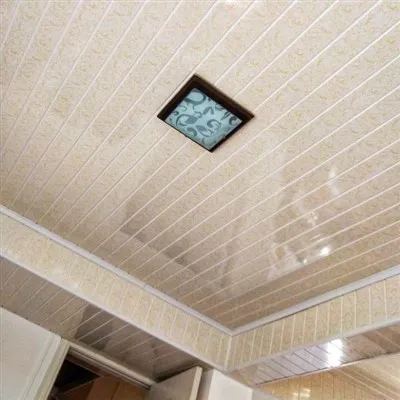
The walls from floor to ceiling are PVC wall panels with a matte stone-texture finish in a warm gray. They lock together along vertical seams that are nearly invisible if you're not looking for them. No grout lines anywhere. The shower area doesn't transition to a different material. It's the same panels, floor to ceiling, with a flexible sealant bead at the tub lip and at the inside corners where panels change plane. That's it. That's the entire water management strategy. The surface itself is waterproof. The seams are tongue-and-groove joints that don't wick. The sealant is the sacrificial layer that gets replaced every few years as routine maintenance. Behind the panels, there is no hidden moisture because there is no path for moisture to get behind them unless the sealant fails and the failure goes unaddressed for years, which is a visible failure with an obvious fix, not a hidden failure that announces itself through mold or peeling paint. The ceiling made several early visitors uncomfortable. A plastic ceiling above a shower sounds institutional. The panels we used have a matte white finish that, at a distance of about 2.4 meters, reads as a smooth painted surface. The difference is that when steam condenses on it, nothing happens. You wipe it with a towel if you feel ambitious, or you let it evaporate. The ceiling doesn't stain. The paint doesn't peel because there is no paint. Six months of daily showers in this bathroom have produced no visible change to the ceiling whatsoever. In a conventionally finished bathroom with the same ventilation, the ceiling above the shower would already be showing the first signs of paint breakdown at the edges. We have a comparison photograph mounted on the wall outside the bathroom showing a painted drywall ceiling in a test room after the same period. The photograph does more than any paragraph could.
The bathroom floor is the same SPC as the living area, which surprises people. The concern is always slip resistance. The planks we used have a textured surface that provides grip under wet feet, and the click-lock joints are tight enough that standing water sits on the surface rather than seeping through. After six months of wet feet, spilled shampoo, and mopping with whatever cleaning product the person tidying the show house happened to grab, the floor shows no joint swelling, no edge peaking, no surface clouding. The floor doesn't care about the bathroom. Compare that to the fate of laminate or engineered wood in the same conditions, where one unnoticed puddle at a seam can permanently swell the core. We documented exactly that failure mode in our SPC vs wood vs tile comparison. The show house bathroom is that comparison made physical.
The laundry nook, a tiny space off the kitchen, got the same treatment: PVC walls, PVC ceiling, SPC floor. In a conventional house, the laundry is the room where materials go to die because nobody budgets for good surfaces in a room that guests never see. In this house, the laundry looks exactly like the bathroom: clean, bright, impervious. A washing machine hose has already leaked once during testing. The water sat on the SPC floor until someone noticed it and mopped it up. The floor didn't swell. The baseboard didn't wick. The wall panels at floor level didn't absorb anything. The event was a non-event. That's the test the laundry room is supposed to fail, and it didn't.
Where Grease Meets Gravity
The kitchen is the room where surface failures are most democratic. Grease doesn't care how much you spent on your backsplash. It settles everywhere. It polymerizes into a sticky film that grabs dust. It resists mild cleaners and laughs at water. If the surface behind the grease is painted drywall, the only cleaning option that works also degrades the paint over time. If the surface is tile, the tile itself wipes clean but the grout absorbs a mixture of grease and cleaning product that slowly darkens and never lightens completely.
In the show house kitchen, the wall behind the stove and the wall behind the sink are PVC panels with the same stone-texture finish as the bathroom. The logic is almost too simple to articulate: these are the two zones in a kitchen where liquids, oils, and steam concentrate, so these are the two zones where the wall surface shouldn't be absorbent. The remaining walls are painted drywall, and that works because in this kitchen layout, the cooking plume doesn't reach them. The specification is zoned rather than blanket. Some visitors ask why we didn't do the whole kitchen in PVC panels. The answer is that we wanted people to see the boundary. To stand at the transition and ask themselves: on this side, I can scrub with degreaser. On that side, I'd need to repaint. Where would I rather be cooking? The question answers itself. The ceiling above the cooktop is PVC for the same reason the bathroom ceiling is PVC. Grease aerosolizes and rises. A painted drywall ceiling above a stove yellows within months and cannot be cleaned without repainting because the paint absorbs the grease. A PVC ceiling panel wipes clean with the same degreaser you use on the countertop. Six months of cooking in the show house kitchen, including several deliberate "worst case" tests where we fried fish without using the range hood, and the ceiling panel still wipes back to its original color. The painted ceiling in our comparison test room didn't survive two frying sessions before showing a visible color shift.
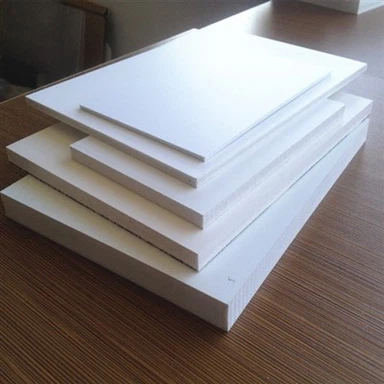
The cabinets are where the kitchen makes its quietest argument. They're built from PVC cabinet board, which is the same dense PVC foam we described in our kitchen cabinet panel guide. The cabinet under the sink has no drip tray. We left it exposed deliberately. Water drips from the trap fitting during testing, pools on the cabinet floor, and gets wiped up. The board doesn't swell. A particleboard cabinet in the same position would have a visible watermark and a raised rim where the melamine facing delaminated. The PVC cabinet has neither. Visitors open this cabinet, touch the bottom panel, feel that it's smooth and flat, and sometimes close it and open it again as if they didn't trust the first finding. We keep a piece of water-damaged particleboard cabinet on the counter beside the SPC cross-section sample. Side by side, the difference needs no explanation.
The Open Floor, the Quiet Ceiling, and the Wall Nobody Notices
The living and dining area is the largest continuous space in the show house, and it's where the floor has to do its work most publicly. This is the zone where furniture sits for months, where a dining chair gets pushed back from the table a hundred times a week, where the dog that several staff members bring to the show house runs in from outside with damp paws. The SPC floor here is the same 6.5mm plank as everywhere else, and it has developed no scratches, no scuffs that don't wipe away, no joint gaps, no change in surface sheen. The area in front of the sofa, where traffic concentrates into a predictable path, looks the same as the area under the dining table. That uniformity of wear is something traditional flooring materials struggle to deliver. Hardwood develops paths. Laminate wears through its photographic layer in high-traffic zones. Carpet compresses and stains. SPC's wear layer, a transparent PVC film 0.5mm thick in this installation, distributes abrasion across a large enough area that no single spot takes a visible beating.

The ceiling in the living area is painted drywall, not PVC. This is a deliberate specification choice that visitors frequently question. Why put PVC on the bathroom and kitchen ceilings but not here? The answer is in the conditions. The living area ceiling faces nothing but stable indoor air and the occasional dust. No steam, no grease, no condensation cycle. Painted drywall performs perfectly well in that environment for years with no intervention. Putting PVC on this ceiling would add cost without adding benefit. The show house makes its case by being selective, and visitors who notice the specification difference tend to understand the logic without having it explained: match the material to the condition, not the other way around. The walls in this space are where the show house makes its most subtle visual argument. They're painted drywall. They look like walls. The baseboards are PVC, which nobody notices. The corner trims where the walls meet the ceiling are PVC profiles that match the baseboards in color and profile, which nobody notices either. The fact that nobody notices is the achievement. The PVC trim does its job invisibly: it covers joints, protects corners, and doesn't swell, stain, or peel. Guests comment on the floor, on the bathroom, on the kitchen cabinets. Nobody says "nice baseboards." That's a success. The best building materials are the ones you stop seeing after the first week.
Stepping Outside: Where the Same Material Faces the Weather
The show house has a small covered porch on the side, and a fenced yard that runs the length of the property. This is where the PVC material platform steps outside and encounters conditions that indoor surfaces never see: direct UV, rain, wind-blown debris, soil moisture at the post bases, and the daily cycle of heating and cooling that works every joint and fastener.
The porch railing is a PVC railing system in white. It's been through a summer of direct afternoon sun and a winter of freezing nights, and the top rail is still smooth, still uniformly colored, and still solidly mounted. The hollow profile doesn't retain enough heat to become uncomfortable to touch even on the hottest days, which was one of the design questions we specifically wanted to test. A solid PVC rail can get warm. A hollow one dissipates heat quickly enough that it never becomes a problem. The railing color matches the fence color exactly because both are the same white compound through their entire thickness. There's no paint to peel, no surface layer to delaminate. A scratch reveals the same white material underneath. The visual continuity from porch railing to yard fence is what gives the exterior of the show house its coherence, and several visitors have commented on it without being able to name why the house looks "finished." It looks finished because the perimeter doesn't switch materials halfway around the property. The PVC fence along the property line is the quietest part of the entire show house project. It went up. It's stayed up. Nothing has happened to it. The posts are set in concrete below the frost line. The panels slot between them. The color is uniform. The surface hasn't chalked or faded. The fence doesn't need painting, staining, sealing, or any of the recurring treatments that a wooden fence in the same location would have already received at least once by now. When visitors walk the property line, they sometimes reach out and touch the fence surface, as if expecting it to feel like painted wood. It doesn't. It feels like a dense, smooth, low-gloss material that is itself, not a coating over something else. The fence is the strongest argument in the show house for PVC's outdoor application, because it does absolutely nothing except stand there and define a boundary, which is what a fence is supposed to do. The wooden fence we installed beside it for comparison purposes has already required one coat of stain and is developing a slight lean on the third post from the end. The comparison display does more work than any specification sheet ever could.
Six Months In, What We'd Keep and What We'd Adjust
The show house has been open for six months. It has been walked through by homeowners, contractors, architects, and distributors. Their questions have sharpened our own understanding of what works and what we'd change.
The bathroom specification is the part we wouldn't alter at all. Floor-to-ceiling PVC wall panels with a matte finish, PVC ceiling, SPC floor. Every visitor who walks out of that bathroom says some version of "I want this in my house." The visual is clean and contemporary. The absence of grout is the feature everybody notices first and appreciates most. The ceiling is the feature they didn't expect to care about and end up asking the most questions about, because everyone has a bathroom ceiling story and nobody has a bathroom ceiling solution.
The kitchen's zoned approach, PVC panels only in the splash zones and painted drywall elsewhere, has held up well but we'd consider extending the PVC wall coverage to the entire cook wall plus one meter on either side. The grease plume in our test kitchen spread slightly wider than anticipated during high-heat cooking, and while the painted drywall at the edges isn't damaged, it has required more cleaning attention than the PVC panels. The lesson is that the splash zone is slightly larger than the area directly behind the stove, and the specification should reflect that.
The SPC flooring across all indoor spaces has been the most uneventful part of the entire project. Uneventful is the goal. The floor hasn't required anything except mopping. The cork underlayment was the right call for acoustic comfort. The 6.5mm thickness is adequate for this application, though if we were building the house again with underfloor heating, we'd drop to 5.5mm to reduce thermal resistance, a trade-off we explore in our thickness guide.
The fence and railing are where the show house makes its case without saying a word. None of the outdoor PVC has required any maintenance. None of it shows any visible change. The comparison wooden fence beside it is already a year into its deterioration arc. The two fences, side by side, same orientation, same weather, different materials, will tell an increasingly clear story as the years accumulate. That story is the reason we built the house.
What Visitors Ask Most Often
Questions that come up repeatedly during show house walk-throughs, and how we answer them.
Q1: Does the whole house feel like plastic when you're inside it?
A: This is almost always the first question, and it comes from an expectation that "PVC house" means visible plastic everywhere. It doesn't. The living area feels like a normal living area with a nice wood-look floor and painted walls. The bathroom feels like a clean, modern wet room. The kitchen splash zone reads as a textured wall finish. The fence outside looks like a painted white fence that happens to never need paint. The only surface in the entire house that occasionally reads as "plastic" to a visitor is the high-gloss version of our wall panels, which we don't use in the show house for exactly that reason. Matte finishes eliminate the plastic look. If you're uncertain, visit a showroom or order samples before committing. Seeing a panel in person under your own lighting will answer this question better than any description can.
Q2: What happens to the PVC wall panels if they get scratched or dented?
A: We tested this deliberately. A sharp object swung hard enough will leave a mark. The difference from drywall is that a dent or scratch on a PVC panel is cosmetic, not structural. Drywall damage exposes gypsum and breaks the paper facing. PVC damage exposes the same material underneath. Minor surface scuffs can be buffed out with a melamine cleaning sponge. Deeper gouges mean the panel needs replacing, which involves removing the damaged panel from its mounting clips or cutting it out of its adhesive bed and locking a new panel into place. Panel replacement is a one-day job for a single panel. Drywall repair in a wet area, by contrast, involves cutting, patching, taping, mudding, sanding, priming, and painting across multiple days with drying time between each step. The repair workflow difference is one of the hidden advantages of a panelized wall system in rooms where damage is likely.
Q3: How does the cost of a whole-house PVC specification compare to traditional materials?
A: The upfront material cost of PVC wall panels is higher than painted drywall and comparable to mid-range ceramic tile. The SPC flooring cost is higher than entry-level laminate and comparable to mid-range engineered wood. The fence cost is higher than treated pine and lower than wrought aluminum. What the per-item comparison misses is two things. First, installation speed. PVC panels cover large areas quickly with no drying time between steps. That compresses labor cost compared to tile work, which involves multiple stages with curing gaps. Second, the maintenance cost over ten years essentially disappears. No repainting cycles for bathrooms and kitchens, no grout sealing, no fence staining, no baseboard replacement in wet areas. If you add up ten years of material plus maintenance plus labor for a traditional specification versus a PVC specification, the PVC side often comes out ahead in total cost, not just in reduced hassle. The show house exists partly so people can do that math with their own contractor after seeing the materials in place.
Q4: Can I install PVC wall panels over my existing tile, or do I need to tear it out?
A: You can install over existing tile if the tile is sound, flat, and clean. The surface needs to be degreased and de-glossed before the adhesive goes on. The installation method shifts from clip mounting to direct adhesive bonding. The catch is what's behind the existing tile. If the old grout has failed and moisture has gotten into the substrate behind the tile, covering the tile with PVC panels seals that moisture in and the problem moves to the wall framing. That scenario requires tear-out. If the tile is intact and the grout is sealed, over-tile installation works and saves time and debris. In the show house, we built new, so the panels went onto clean substrate board, but we've done over-tile installations in test rooms that have held up without issue. The decision turns on the condition of the existing surface more than on any inherent limitation of the panel material.
Q5: How do I get samples of the materials used in the show house?
A: Sample shipments are available for flooring planks, wall panel swatches, ceiling panel sections, fence profile cuts, and moulding samples. If you're planning a renovation and want to see the actual materials in your own space under your own lighting, contact our team with the products and finishes you're considering. We'll assemble a sample kit that covers what you need to evaluate. Seeing a sample in your own room tells you more than any show house visit or product photo ever will, because light is local and your eye is yours.
Walk Through It Yourself, or Bring Your Floor Plan
The show house is open for visits. If you're too far to walk through in person, send us your room dimensions and tell us which surfaces are giving you trouble. We'll match the specification logic from this house to your house and send you the material suggestions and sample kit you need to decide. No pitch, no pressure. Just the same evidence-based approach we used to build the house in the first place.
SPC Flooring Details | PVC Ceiling Options | Request Samples
What the House Knows That a Brochure Doesn't
A brochure can tell you that a wall panel is waterproof. Only a house can show you that six months of daily showers have left no trace on the bathroom ceiling. A specification sheet can list the wear layer thickness of a floor plank. Only a floor you walk across in your own shoes can tell you whether it sounds right underfoot. A product photo can show you a white fence against a blue sky. Only a fence you can touch on a hot afternoon can tell you whether the surface is too warm or the color has shifted.
The show house doesn't replace product information. It adds the dimension that product information can't carry, which is time. Materials in a brochure are frozen in the moment of their best appearance. Materials in a house accumulate days and weeks and seasons. They get walked on and steamed up and rained on. What they look like after that accumulation is the only thing that matters, because the house you live in isn't frozen on installation day either.
If you're standing in your own house, staring at a bathroom ceiling with a peeling patch above the shower, or a kitchen floor with grout lines that have gone gray and stayed gray, or a fence that needs painting for the third time in eight years, you already know what the traditional materials in those positions are telling you. They're telling you they weren't designed for the conditions they're facing. The show house is one answer to that problem, built full-scale, with nothing to hide and nothing to sell that the materials can't demonstrate on their own. Come see it. Touch what you want. Open the cabinet under the sink. Run your hand along the fence. Then decide.
YUPSENI Team
The show house represents twenty-three years of watching how building materials behave after the keys change hands. We manufacture SPC flooring, PVC wall and ceiling panels, outdoor fencing and railing, cabinet board, and trim profiles from one facility. That means the materials in this house were designed to work together, not just to look good next to each other in a catalog. Explore our flooring collection or learn how we build.
© 2026 YUPSENI. The show house described in this article is a test and demonstration structure. Performance results reflect the specific products, installation methods, and climate conditions at this location. Your results may vary. Product availability, specifications, and pricing are subject to confirmation at time of inquiry. YUPSENI is a trademark of YUPSENI Building Materials.