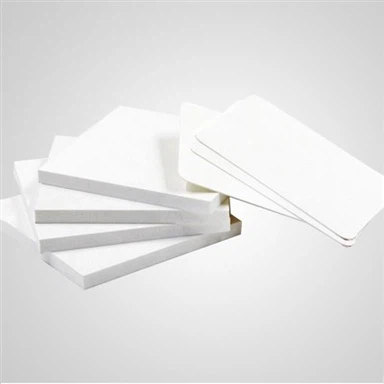
How is Crust PVC Foam Sheet manufactured?
May 26, 2024
Can you explain the difference between Crust PVC Foam Sheet and other types of PVC foam sheets?
Difference between Crust PVC Foam Sheet and other types of PVC foam sheets:
Crust PVC Foam Sheet: Crust PVC foam sheets have a solid outer skin or "crust" layer, which provides added strength, durability, and resistance to impacts and abrasion. This outer layer also enhances the surface finish, making it suitable for printing, painting, or laminating.
Free Foam PVC Foam Sheet: Free foam PVC foam sheets do not have a solid outer skin and are uniformly foamed throughout their thickness. They are lightweight and have good insulation properties but may lack the surface hardness and durability of crust PVC foam sheets.
Celuka PVC Foam Sheet: Celuka PVC foam sheets have a foamed core and a smooth, hard surface achieved through a special extrusion process called Celuka. They offer a balance between the lightweight properties of foam and the surface hardness of solid PVC sheets.
What are the key advantages of using Crust PVC Foam Sheet over traditional materials?
Key advantages of using Crust PVC Foam Sheet over traditional materials:
Lightweight: Crust PVC foam sheets are lighter than traditional materials like wood, metal, or solid PVC sheets, making them easier to handle, transport, and install.
Weather resistance: Crust PVC foam sheets are resistant to weather, moisture, and chemicals, making them suitable for outdoor applications where traditional materials may degrade over time.
Durability: The solid outer skin of crust PVC foam sheets provides added strength and durability, making them more resistant to impacts, scratches, and abrasion compared to traditional materials.
Versatility: Crust PVC foam sheets can be easily cut, shaped, and fabricated to suit different applications and design requirements, offering more flexibility than traditional materials.
Insulation properties: Crust PVC foam sheets offer thermal and electrical insulation, making them suitable for applications where insulation is required, such as in construction or automotive industries.
Surface finish: The smooth surface finish of crust PVC foam sheets allows for easy printing, painting, or laminating, making them ideal for applications where aesthetics are important.
How does the density of Crust PVC Foam Sheet impact its performance?
Impact of density on Crust PVC Foam Sheet performance:
The density of crust PVC foam sheets impacts various aspects of their performance:
Mechanical strength: Higher density crust PVC foam sheets tend to have better mechanical strength, including tensile strength, flexural strength, and impact resistance, compared to lower density sheets.
Surface hardness: Higher density crust PVC foam sheets typically have a harder surface, which enhances their resistance to scratches, abrasion, and indentation.
Dimensional stability: Higher density crust PVC foam sheets generally exhibit better dimensional stability, with less shrinkage or expansion due to changes in temperature or humidity.
Workability: Lower density crust PVC foam sheets may be easier to cut, shape, and fabricate, while higher density sheets may require more effort and specialized tools for processing.
Cost: Higher density crust PVC foam sheets may be more expensive than lower density sheets due to the higher amount of raw material required and the additional processing steps involved in achieving higher density.