PVC vs Wood vs Polyurethane vs MDF Trim: How to Choose by Logic, Not Habit | YUPSENI
Jul 18, 2026
Read time: 9 minutes | By: YUPSENI Team

The same clean white lines a painter used to chase every few years-delivered by a material that holds them for decades.
On This Page
- I. The Question Behind the Question
- II. Five Materials, One Table, No Marketing
- III. Why Interior and Exterior Are Two Different Arguments
- IV. When PVC Is the Wrong Answer
- V. The Profile That Nobody Notices Until It Fails
Walk onto most job sites and the trim material was chosen before anyone thought about it. The crew uses what the crew has always used. The supplier stocks what the supplier has always stocked. Finger-jointed pine for interior casing because that is what is on the rack, primed MDF for baseboard because it is cheap, and cellular PVC outside only when the spec sheet forces it.
Habit is a reasonable default when the stakes are low. Trim is not that. It is the most-touched, most-visible, most-weather-exposed detail on a building, and the material choice determines whether a facade still looks sharp in year fifteen or announces every failed joint by year three.
So here is the decision made on logic instead of habit. What PVC trim and moulding actually competes against, where it wins, and-because no honest guide skips this-where it doesn't.
I. The Question Behind the Question
Ask "what is the best trim material" and you have already asked the wrong question. There is no best. There is only best-for-this-location-under-this-exposure-at-this-budget, and the answer flips completely depending on which of those three variables you fix first.
A trim material has to satisfy an oddly conflicting set of demands. It must machine cleanly like wood, because the trades installing it own woodworking tools and nothing else. It must resist water, because trim lives at exactly the joints and edges where water collects. It must hold paint or arrive pre-finished. It must not move so much with temperature that it tears its own joints apart. And it must cost little enough that a builder will trim an entire house in it, not just the front door.
No single material aces all five. What follows is which trade-offs each one makes.
II. Five Materials, One Table, No Marketing
Here are the five materials that actually compete for a trim spec, scored on the properties that decide the job. Read down the column for the material you were about to default to, and across the row for the property your project cares about most.
| Property | Cellular PVC | Solid Wood | Polyurethane | MDF | Fiber Cement |
|---|---|---|---|---|---|
| Water resistance | Complete | Poor at end-grain | Good | Fails when wet | Good |
| Rot & insects | Immune | Vulnerable | Immune | Swells, no rot data outdoors | Immune |
| Machines like wood | Yes | Yes | Yes | Yes, dusty | Brittle, blade-dulling |
| Holds fasteners | Yes | Yes | Soft, limited | Yes, indoors | Pre-drill needed |
| Pre-finished / paintable | White, paintable | Needs finishing | Primed, paintable | Primed, paintable | Primed, paintable |
| Thermal movement | Notable-glue joints | Low | Low | Low | Very low |
| Weight | Light | Medium | Very light | Heavy | Heavy |
| Best home | Exterior & wet interior | Dry interior, stain-grade | Ornate interior detail | Dry interior, budget | Exterior flat trim |
Two things jump out of that table. First, MDF has no business anywhere water can reach it-a single leaked gutter turns MDF fascia into oatmeal, and that is not an exaggeration of the failure mode, it is a description of it. Second, cellular PVC and fiber cement are the only two materials that combine complete water resistance with immunity to rot and insects, and of those two, only PVC machines with the tools already in the truck. Fiber cement cuts, but it fights back-it is brittle, it eats blades, and it throws silica dust that demands respiratory protection.

Where PVC competes hardest with polyurethane-decorative profiles that need dimensional relief and a clean paintable surface, in a material that also survives the weather.
III. Why Interior and Exterior Are Two Different Arguments
This is the part the habit-driven approach gets most wrong. People pick one trim material and use it everywhere, when the interior and exterior arguments barely overlap.
Inside a dry, climate-controlled room, water resistance is nearly irrelevant. Nobody's living-room baseboard is going to rot. There, the argument is about finish quality, cost, and how the material takes paint-which is exactly why primed MDF and finger-jointed pine hold so much interior market share. They are cheap, they take paint well, and the environment never tests their weakness. The exceptions are the wet interior rooms: bathrooms, laundry rooms, mudrooms, basements. Put MDF baseboard in a bathroom and you have simply scheduled a callback.
Step outside and every priority inverts. Now water resistance is the whole game, and finish nicety is secondary. The exterior is where wood trim goes to die-and where the case for cellular PVC becomes almost one-sided. Fascia behind the gutter, corner boards taking splash-back, window and door surrounds, the sill and drip cap managing rainwater off every opening. These are the failure points, and they are precisely where a material that does not absorb water changes the maintenance math of the entire building.
The rule of thumb worth keeping: indoors, choose trim on appearance and price. Outdoors and in wet rooms, choose it on water behavior. Using one material for both is convenient for the purchase order and expensive for the maintenance schedule.
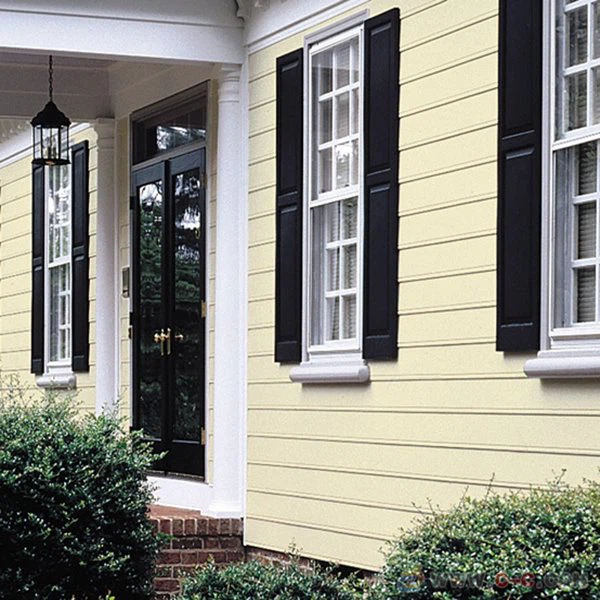
Exterior window trim-the casing, sill, and drip cap around an opening are where a facade either sheds water or slowly drinks it. PVC does the former by default.
IV. When PVC Is the Wrong Answer
A guide that only lists a material's wins is an advertisement, not information. Cellular PVC has real limits, and knowing them is how you avoid specifying it into a job it will underperform.
It moves with temperature. More than wood, more than fiber cement. On a long exterior run in full sun, that thermal expansion is real, and it is the reason every PVC joint must be glued rather than merely nailed-a glued joint welds into one continuous piece that moves as a unit, while a nailed-only joint eventually telegraphs a gap. This is completely manageable, but it is a discipline the installer has to actually follow, not an option.
It is not a stain-grade product. If the design calls for the visible grain and warmth of natural wood finished clear, PVC cannot give you that-it is a paint-or-white material, and pretending otherwise sets up disappointment. And it carries no structural load. Trim is trim; if a member needs to hold weight, that is a job for framing lumber or engineered wood, not for any trim material including this one.
On raw material cost against builder-grade MDF for a dry interior baseboard, PVC usually sits higher. If the room will never see moisture and appearance is all that matters, that premium may not pay back. The honest verdict: PVC earns its price where water, weather, or wet interior conditions are in play. In a permanently dry room on the tightest budget, cheaper materials can be the rational call.
V. The Profile That Nobody Notices Until It Fails
There is one part of the trim system that is not decorative at all, and it is the part most likely to cause an expensive problem when the wrong material is used: the sill and drip cap.
These profiles are the building's rain-management hardware disguised as trim. A sill sheds water off a window ledge; a drip cap forces rainwater to fall clear of the joint above an opening instead of wicking back into it. When they work, nobody thinks about them. When they fail-usually because they were made of wood that rotted, or MDF that swelled-water gets behind the cladding and the damage is structural, not cosmetic. This is the one profile where specifying a waterproof material is not an upgrade; it is basic risk management. It is also why a full trim system matters more than any single board: casing, sill, drip cap, corner board, and fascia all have to agree on how water leaves the wall.
The practical advantage of sourcing the whole set from one PVC profile family is that the water story is consistent all the way around the opening, in one matched white finish, from one supplier. For the profile that draws the most eyes, our white PVC crown moulding guide goes deeper, and the full case against wood is laid out in why wood trim fails and what replaces it. Browse the complete profile set in the trim and moulding range or the dedicated PVC moulding line.
Frequently Asked Questions
Frequently Asked Questions About PVC Trim and Moulding
Common questions from builders, importers, and distributors comparing trim materials.
Q1: Is PVC trim better than polyurethane for decorative moulding?
A: They overlap on interior decorative profiles, where both hold fine detail and take paint. PVC pulls ahead when the profile also needs to survive moisture or exterior exposure, and it holds fasteners more securely than the softer polyurethane. Polyurethane can be the lighter choice for very ornate, purely interior detail work with no water risk. For exterior crown, casing, or any wet-area profile, cellular PVC is the more robust specification.
Q2: Can I use PVC trim indoors, or is it only for exteriors?
A: Both. Its strongest interior case is in wet rooms-bathrooms, laundry rooms, basements, mudrooms-where MDF and wood fail. In permanently dry rooms on a tight budget, cheaper interior materials can be rational, since the environment never tests PVC's water advantage. Many builders standardize on PVC throughout for the single benefit of one material, one finish, and one maintenance story across the whole house.
Q3: Does PVC trim expand and contract enough to cause problems?
A: It moves more with temperature than wood, which is why every joint must be glued with PVC cement rather than only nailed. A glued joint bonds into one continuous piece that moves as a unit and stays closed. A nailed-but-unglued joint can open a hairline gap over seasonal cycles. Follow the glue-and-fasten rule and thermal movement is a non-issue; skip it on a long sunny run and it will show.
Q4: Do the sill and drip cap really need to be waterproof?
A: Yes-this is the profile where material choice has structural consequences, not just cosmetic ones. Sill and drip cap manage rainwater off and away from openings. When they are made of wood that rots or MDF that swells, water gets behind the cladding and the resulting damage is expensive. Specifying a waterproof material here is basic risk management, and it is a strong reason to source a full matched profile set rather than mixing materials around an opening.
Q5: Why source a whole trim system from one supplier instead of mixing?
A: Two reasons. Color and finish match-trim board, crown, casing, sill, and drip cap from one PVC family share the same white so the sheen and shade are consistent across the facade. And water continuity-the profiles around each opening all handle rainwater the same way, with no weak link where a different material was substituted. One supplier, one finish, one water story. Contact us for the full profile and size chart.
Trim the Whole Building From One PVC Family
BODO® trim board and moulding-waterproof, termite-proof, never rots, works with standard tools. Crown, casing, sill, drip cap, and trim board in one matched white finish. Free samples for qualified buyers.
Browse the Full RangeYUPSENI Team
23 years in PVC building material manufacturing and supply chain. We help importers, distributors, and project buyers source PVC trim, moulding, foam board, and fencing that perform right the first time. More about YUPSENI
© 2026 YUPSENI. All rights reserved. The information in this article is for general informational purposes only and does not constitute professional advice. Material comparisons are generalized; performance depends on grade, installation, and exposure. Confirm suitability against local building code and current datasheets before making procurement decisions.