PVC Ceiling Boards: Waterproof Ceiling Panels for Bathrooms, Kitchens & Outdoor Soffits | YUPSENI
Jun 24, 2026
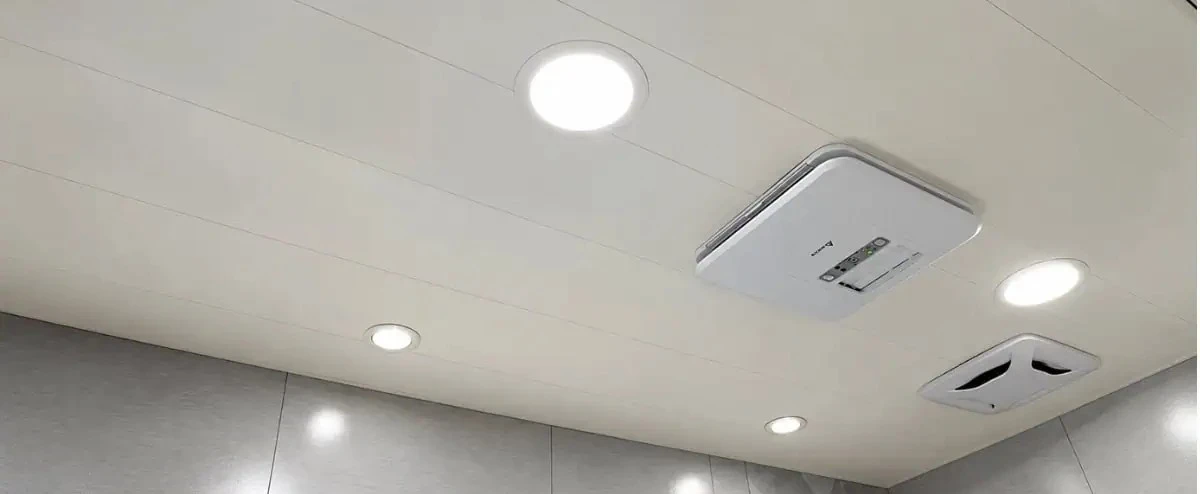
PVC ceiling panels installed in a residential kitchen. The tongue-and-groove joint system produces a near-seamless surface. The material does not absorb cooking moisture, does not sag, and wipes clean with a damp cloth. No paint, no plaster, no repeat visits.
Nobody walks into a room and looks up first. The ceiling is the last surface anyone notices. It is also the surface most likely to fail in the rooms where failure is most expensive: kitchens, bathrooms, laundry rooms, basements, covered outdoor areas. Steam rises. Condensation collects. Gypsum sags at the seams. Mineral fiber tiles stain brown at the first plumbing leak. Paint peels in sheets after two years above a shower.
PVC ceiling boards solve this problem by removing the ceiling from the moisture equation entirely. The material is waterproof. Not water-resistant, not moisture-tolerant. Waterproof. It does not absorb water, does not swell, does not delaminate, and does not provide a food source for mold. A PVC ceiling above a shower looks the same at year ten as it did on installation day because nothing has penetrated the surface in the intervening decade to change it.
The product is not new. It has been installed in Southeast Asian and Middle Eastern residential and commercial projects for over fifteen years. What is new is the rate at which it is replacing gypsum, mineral fiber, and painted plaster in Western renovation and new-build specifications. The shift is being driven by installers, not by architects. Installers are the ones who get called back when a bathroom ceiling stains. They are the ones who quoted the job assuming one visit and ended up making three. PVC ceiling boards, once they have been installed correctly, generate zero callbacks for moisture-related failure. The installer's incentive to switch is stronger than any marketing budget. For the full product range - standard planks, drop-ceiling tiles, decorative coffered panels, and outdoor-grade boards - the PVC ceiling board product catalog includes specifications for every format.
On This Page
- I. What a PVC Ceiling Board Actually Is, and What It Is Not
- II. A Material That Earns Its Keep in the Wettest Room of the House
- III. PVC vs Gypsum vs Mineral Fiber: The Ceiling Comparison Most Builders Get Wrong
- IV. Tin, Timber, and Plaster: The Looks That Hide the Polymer
- V. Installation: Why the Tongue Clicks Once and Stays Clicked
- VI. Outdoor Ceilings: The Use Case Nobody Thought Of Until the Soffit Rotted
I. What a PVC Ceiling Board Actually Is, and What It Is Not
A PVC ceiling board is an extruded rigid polyvinyl chloride sheet, typically between 5 mm and 10 mm thick, with a tongue-and-groove edge profile that allows adjacent boards to lock together along their length. The face surface is finished at the factory: high-gloss white, matte white, woodgrain emboss, metallic-look film, or patterned decorative laminate. The back surface is flat and, in most products, carries a slight texture to improve adhesive bond if the boards are being glued to a substrate rather than mechanically fastened to a grid or furring strip.
The material is the same polymer family as PVC plumbing pipe. It does not rot. It does not rust. It does not absorb water. It does not support mold growth because there is nothing organic in it for the mold to eat. It expands and contracts with temperature at a predictable rate, which the installation method accommodates with perimeter expansion gaps. It is lighter than gypsum board per square meter, which matters when the installer is working overhead with arms raised for hours at a time.
What a PVC ceiling board is not: it is not a structural material. It cannot span between joists the way gypsum can. It requires a substrate or a grid system behind it. It is not a fire-rated membrane in the way Type X gypsum is, though fire-retardant formulations are available for commercial applications that require them. And it is not a vapor barrier on its own. The tongue-and-groove joints, while tight, are not hermetic. If the space above the ceiling requires a continuous vapor barrier, that barrier must be installed separately behind the PVC panels.

Cross-section of a standard PVC ceiling board. The hollow-chamber construction reduces weight without sacrificing rigidity. The tongue-and-groove edges lock adjacent boards together and conceal the mechanical fasteners behind the visible face.
II. A Material That Earns Its Keep in the Wettest Room of the House
The bathroom is where gypsum ceilings go to die. A shower generates steam at close to 100% relative humidity. That steam rises, hits the ceiling, and if the ceiling is painted gypsum, the moisture begins a slow migration into the gypsum core through the paint film. The paint film is a semi-permeable membrane. It slows moisture ingress but does not stop it, and over hundreds of hot-shower cycles the gypsum core accumulates enough moisture to soften at the fastener heads and sag between the joists. The sag is gradual. It becomes visible as a shallow bowl shape at the center of each joist bay, noticed first when the bathroom light casts a shadow that was not there before.
A PVC ceiling board does none of this. Moisture that condenses on the surface beads up and either evaporates or is wiped off. It does not enter the material. The board does not swell, does not soften, and does not lose its mechanical connection to the substrate. A PVC ceiling for bathrooms is the default specification in most new-build apartment projects in humid climate zones for precisely this reason. The product costs more per square meter than gypsum at the point of purchase, but it costs nothing in callbacks over the following decade.
The kitchen presents a different moisture problem. Cooking generates aerosolized oil droplets in addition to steam. These droplets deposit on every upward-facing surface and combine with dust to form a sticky film that is difficult to remove from textured paint or mineral-fiber tiles. PVC ceiling boards have a smooth, non-porous face that releases this film with a single pass of a damp cloth and mild detergent. The cleaning difference between wiping a PVC ceiling and scrubbing a painted gypsum ceiling above a stove is the difference between a five-minute task and a task that homeowners simply do not do until the ceiling turns yellow enough to justify repainting the entire room.

PVC ceiling planks above a bathtub. The surface beads condensation and dries without leaving watermarks. After ten years of daily shower steam exposure, this ceiling will show the same surface finish as day one.
III. PVC vs Gypsum vs Mineral Fiber: The Ceiling Comparison Most Builders Get Wrong
Builders compare ceiling materials by price per square meter. This is a mistake that systematically favors gypsum and systematically understates the true cost of gypsum in wet and semi-wet locations.
The installed cost of gypsum board includes hanging, taping, mudding, sanding, priming, and painting. The painting step alone requires drop cloths and masking because it happens after the walls are finished. A PVC ceiling board system installs after the walls are done, with no wet trades involved, no dust, and no drying time. The installed cost comparison narrows significantly once labor is included, and in renovation scenarios where the existing ceiling is being replaced rather than built new, the installed cost of PVC is often lower because the demolition of old gypsum and the disposal of gypsum debris add cost to the gypsum replacement that PVC replacement does not carry if the existing substrate can be left in place.
| Property | PVC Ceiling Board | Gypsum Board | Mineral Fiber Tile |
|---|---|---|---|
| Water resistance | Waterproof | Absorbs water | Stains, sags |
| Mold resistance | Inherent | MR grade available | MR grade available |
| Installation dust | Zero | Sanding dust | Low |
| Finish required | Factory finished | Paint, multiple coats | Factory finished |
| Weight | Light | Heavy | Light |
| Service life in wet area | 20+ years | 5–8 years | 5–10 years |
The comparison that matters is installed cost over service life in the target room. In wet areas, PVC wins on that metric before year five. In dry areas, gypsum retains a material-cost advantage that narrows when installation labor and finishing steps are included.
Mineral fiber drop-ceiling tiles are the standard commercial specification for offices and retail spaces because they provide acoustic absorption and plenum access above the ceiling. They also stain permanently at the first plumbing leak from the floor above. One leaking toilet supply line turns a section of mineral-fiber ceiling into a brown-ringed liability that must be replaced. PVC ceiling tiles in the same drop-grid format - available as PVC drop ceiling tiles in standard 60 cm by 60 cm and 60 cm by 120 cm formats - solve the staining problem without changing the grid infrastructure. The tiles drop into the same T-bar grid. They weigh approximately the same as mineral fiber. They do not absorb water and they wipe clean with the same ease as the plank-format panels used in residential ceilings. For commercial spaces where plumbing leaks are a question of when rather than if, the switch from mineral fiber to PVC tiles is one of the cheapest long-term ceiling decisions a facility manager can make.
IV. Tin, Timber, and Plaster: The Looks That Hide the Polymer
PVC ceiling panels do not look like PVC anymore. The surface film and embossing technology available on current-generation products replicates the visual texture of traditional ceiling materials closely enough that the difference is not detectable from standing height. A PVC ceiling board with a woodgrain emboss and a matte lacquer finish reads as painted timber from two and a half meters below it. A metallic-finish PVC tile in a coffered pattern reads as pressed tin. A high-gloss white panel with a subtle decorative groove reads as a premium painted surface that has been maintained to an unrealistic standard.
The three finish families available as standard catalog items cover the majority of residential and commercial applications:
High-gloss white. The default finish. Maximum light reflectance, which matters in bathrooms and kitchens where the ceiling is a secondary light source bouncing illumination from wall fixtures and under-cabinet lighting into the room. A high-gloss PVC ceiling increases perceived room brightness by a non-trivial margin compared to a matte painted gypsum ceiling, and it does so without requiring repainting to maintain the reflectance as the paint ages and yellows.
Woodgrain and timber-look. Warm-toned panels with registered embossing that aligns the surface texture with the printed grain pattern. Used in residential living spaces, hospitality interiors, and anywhere the specification calls for a natural material look without the maintenance liability of actual timber in a ceiling application. A timber-look PVC ceiling above an outdoor covered patio reads as a design choice rather than a moisture accommodation.
Decorative and metallic. Coffered patterns, tin-look tiles, and decorative plaster-style panels for spaces where the ceiling is intended to be noticed rather than ignored. These are the products that compete with pressed-metal ceilings in heritage renovations and with decorative plaster in high-end residential. The PVC version costs a fraction of its historical counterpart and installs in hours rather than days.


Three PVC ceiling finishes. Left to right: woodgrain emboss with registered grain texture, metallic tin-look tile, and white decorative coffered panel. All three carry the same waterproof substrate; only the surface film and embossing differ.
V. Installation: Why the Tongue Clicks Once and Stays Clicked
PVC ceiling boards install by one of two methods. The first, and more common for plank-format products, is mechanical fastening through the tongue flange into timber furring strips or a metal grid. Each board is positioned, the tongue is stapled or screwed through at intervals, and the groove of the next board covers the fastener heads. The installer sees each fastener during installation. The occupant sees none of them after.
The second method, used for tile-format products and for installations over existing surfaces, is adhesive bonding directly to a flat substrate. A construction adhesive rated for PVC is applied in beads to the back of the board, the board is pressed into position, and the tongue-and-groove connections hold it in place while the adhesive cures. This method is particularly useful in renovation scenarios where the old ceiling is sound but cosmetically compromised. The PVC boards go over the top without demolition.
Installation produces no dust, no wet compound that requires drying time, and no volatile organic compounds beyond the adhesive's curing emissions if the adhesive method is used. A two-person crew can install a standard residential bathroom ceiling in PVC in roughly two to three hours from first board to final trim. The same ceiling in gypsum, including taping, mudding, sanding, and painting, takes three site visits spread across a minimum of three days to account for compound drying time.
The critical installation detail is the perimeter expansion gap. PVC boards expand and contract with temperature. A gap of 5 mm to 8 mm around the entire perimeter, concealed by a cove molding or edge trim, allows the ceiling to move without buckling. Installers who neglect this gap and butt the boards tight against the walls will see the ceiling develop a wave on the first hot day after installation. The gap is not optional.
VI. Outdoor Ceilings: The Use Case Nobody Thought Of Until the Soffit Rotted
Covered outdoor areas present the worst of all ceiling environments. The ceiling is protected from direct rain but fully exposed to ambient humidity, temperature swings, and wind-driven moisture at the edges. Plywood soffits delaminate at the exposed edges. Painted gypsum soffits fail within two years as moisture migrates through the paint from the back side. Metal soffits corrode at the fastener points in coastal environments.
PVC ceiling boards in an outdoor-grade formulation - with a co-extruded UV cap layer that protects the substrate from sun exposure at the perimeter - solve the outdoor soffit problem with the same material properties that work indoors. The boards do not absorb moisture from humid air. They do not delaminate. They do not corrode. The installation method is the same tongue-and-groove mechanical fastening used indoors, with stainless steel fasteners substituted for the standard coated staples to eliminate the risk of rust streaks in exposed-edge applications.
The outdoor PVC ceiling market is growing faster than the indoor market in several of the regions served by this product category. Southeast Asian residential construction has adopted PVC outdoor ceiling panels as a standard specification for covered terraces, carports, and balcony soffits. Middle Eastern projects use them under pergolas and shaded outdoor seating areas where daytime temperatures exceed 40 degrees Celsius and thermal cycling would destroy a painted gypsum soffit within a single season. The outdoor-grade PVC ceiling panels in the product line carry a co-extruded cap layer specifically formulated for these conditions.
Quick Questions
Frequently Asked Questions About PVC Ceiling Boards
Answers to the most common questions from installers, builders, and homeowners evaluating PVC ceiling boards for the first time.
Q1: Can PVC ceiling boards be installed over an existing ceiling?
A: Yes. If the existing ceiling surface is flat and structurally sound, PVC ceiling boards can be adhesive-bonded directly over it. This is one of the product's strongest selling points in renovation: no demolition, no disposal, no dust. The existing ceiling must be dry, clean, and free of loose paint or peeling material. Furring strips screwed through the old ceiling into the joists provide a mechanical fastening substrate if the existing surface is too uneven for direct adhesive bonding.
Q2: What sizes do PVC ceiling boards come in?
A: Standard plank widths range from 100 mm to 400 mm, with 200 mm and 250 mm being the most common. Lengths are typically 2,400 mm to 3,000 mm for plank-format products. Tile-format products for drop-ceiling grids are available in 600 mm × 600 mm and 600 mm × 1,200 mm standard sizes. Full-size sheets at 1,220 mm × 2,440 mm are available for large-area commercial installations where fewer joints are desired. Custom dimensions can be quoted for container-volume orders.
Q3: Do PVC ceiling boards yellow over time?
A: High-quality PVC ceiling boards from a manufacturer using titanium dioxide UV stabilizers in the surface layer will not yellow under normal indoor conditions. White panels installed in bathrooms and kitchens with no direct sun exposure retain their color indefinitely. Panels installed in sun-exposed locations - near skylights, in sunrooms, or outdoor covered areas - require a UV-stabilized formulation. Standard indoor-grade panels will yellow in direct sun over several years. Outdoor-grade panels with a co-extruded UV cap layer will not.
Q4: How do you cut PVC ceiling boards?
A: With standard woodworking tools. A fine-tooth handsaw, a circular saw with a fine-finish blade, or a jigsaw will all cut PVC ceiling boards cleanly. The material is softer than timber and cuts with less resistance. A utility knife can score and snap thin panels under 5 mm, though the cut edge will be less clean than a saw cut. No special blades are required, but a blade with more teeth produces a cleaner edge with less burring on the cut face.
Q5: Are PVC ceiling boards fire-safe?
A: Standard PVC ceiling boards achieve a Euroclass E fire rating, which is acceptable for residential ceiling applications in most jurisdictions. PVC is inherently flame-retardant compared to many other plastics because of its chlorine content - it self-extinguishes when the flame source is removed. For commercial projects requiring a higher fire rating, fire-retardant formulations are available that achieve Euroclass B. Always confirm local building code requirements for ceiling lining fire ratings before specifying.
Q6: Can PVC ceiling boards be painted?
A: Yes, but it defeats the purpose. One of PVC's primary advantages is that it never needs painting. If a color change is desired after installation, acrylic latex paint with a bonding primer rated for plastics will adhere. The surface must be cleaned and lightly scuffed before priming. However, once painted, the ceiling enters a repainting cycle that the material was designed to eliminate. Choose the factory color carefully at the specification stage.
PVC Ceiling Boards - Factory Direct, Free Samples Available
Planks, tiles, and full-size sheets in gloss white, woodgrain, metallic, and decorative finishes. Standard and fire-retardant grades. Tell us your dimensions and destination port. We respond with pricing, lead time, and a sample within 24 hours.
The Ceiling That Pays for Itself on the First Callback It Prevents
The economics of PVC ceiling boards become compelling when the comparison shifts from material cost per square meter to installed cost over the expected service life of the room. In a bathroom, that service life is fifteen to twenty years between renovations. A gypsum ceiling in that bathroom will be repainted at least twice, possibly replaced once if the shower moisture has caused sagging at the joist bays. A PVC ceiling will be wiped with a damp cloth once or twice a year and otherwise ignored. The material cost difference between the two options, spread over twenty years, is less than the cost of one ceiling repaint.
The installer's math is even simpler. A PVC ceiling in a standard residential bathroom is a single-visit job with no drying time, no dust containment, and no callback for peeling paint six months later. A gypsum ceiling in the same room is a three-visit job across a minimum of three days, with dust containment throughout, and a non-zero probability that the homeowner will call about nail pops or seam cracks within the first year. The installer who switches to PVC for wet-area ceilings is not making a material choice. They are making a risk-management choice that expresses itself in freed-up schedule time and eliminated warranty visits.
For procurement teams, distributors, and project buyers sourcing PVC ceiling boards at volume, the factory-direct supply chain removes the margin layers that would otherwise make the product uncompetitive against commodity gypsum. YUPSENI manufactures the boards on dedicated extrusion lines in Shandong, ships in consolidated containers alongside complementary product categories, and provides the batch-level QC documentation that regulated import markets require at the destination port. The ceiling is the last surface anyone notices. It should also be the last surface anyone needs to think about after it is installed.
YUPSENI Team
23 years in PVC building material manufacturing and supply chain. PVC ceiling boards, wall panels, SPC flooring, foam boards, and fencing manufactured on a consolidated production campus in Shandong, China. Factory-direct pricing with batch-level QC documentation included as standard. More about YUPSENI
Disclaimer: The information in this article is for general product reference purposes only. Building code requirements for ceiling lining materials vary by jurisdiction. Fire rating, installation method, and substrate compatibility must be verified against local regulations and the manufacturer's written installation instructions. Product specifications are subject to confirmation at the time of order.