
PVC Marker Posts: 5 Parameters That Separate Disposable Products From 10-Year Boundary Markers

May 20, 2026

⏱ ~10 min read  Updated: May 20, 2026  By YUPSENI Team

On This Page

  1. Parameter 1: Base Resin Formula - Virgin vs. Recycled Material
  2. Parameter 2: Wall Thickness & Structural Rib Design
  3. Parameter 3: Surface Marking Durability - Four Generations of Technology
  4. Parameter 4: Impact Toughness & Low-Temperature Embrittlement
  5. Parameter 5: Below-Ground Anchoring System Design
  6. The Long-Term Return: Purchase Price Is Only 20% of Total Cost
  7. FAQ

Durable PVC marker posts installed at property boundary construction site and utility line showing clear legible signage and upright stability after years of outdoor exposure

Silent sentinels of the built environment - quality PVC marker posts retain crisp, legible markings and structural integrity through a decade of sun, freeze-thaw cycles, and vehicle contact, while disposable alternatives fade and fracture within a single season.

In real estate development, property management, municipal engineering, agricultural park demarcation, and utility corridor marking, marker posts serve as silent boundary sentinels. They indicate pipeline routes, land ownership boundaries, and facility locations - forming the baseline guarantee of order and safety across the built landscape. Yet the quality gap in the marker-post market is staggering. Some products, barely a year after installation, exhibit fading, warping, brittle fracture, and complete loss of legible markings - reduced to single-use consumables. Others withstand sun, freeze-thaw cycling, and vehicle impact in punishing outdoor conditions, remaining structurally sound and clearly legible for ten years or more, silently witnessing land parcels change hands and infrastructure evolve around them.

Faced with a bewildering array of products, buyers repeatedly hit the same wall: they all look like red-and-white plastic posts from the outside - how do I tell which one will last ten years? The answer lives inside five key technical parameters. This article unpacks each one, equipping procurement professionals, project engineers, and property managers with the hard metrics needed to identify genuinely durable marker posts and sidestep the costly trap of low-quality disposables. 

Parameter 1: Base Resin Formula - Virgin vs. Recycled Material

The skeleton of any marker post is its polymer matrix. The two dominant materials in the market are PVC (polyvinyl chloride) and PE (polyethylene). Raw material cost accounts for 40–60% of the total product cost - making this the most common site of cost-cutting by unscrupulous manufacturers.

The Two Sides of the Formula Coin

Attribute Disposable (Recycled Material) 10-Year Grade (Virgin Resin)
Material Source Heavy recycled waste plastic, regrind, and regrind; often adulterated with stone powder (CaCO₃ filler) to further reduce cost 100% virgin PVC or PE resin; compounded with 3–5% UV absorbers (UV-531, UV-326), antioxidants (1010, 168), and lightfast pigment masterbatch
Surface Appearance Rough, grainy texture; dull, greyish coloration; surface chalk detectable by fingernail scratch Smooth, uniform surface; vibrant, saturated color; no chalk or graininess
Weathering Performance Chalking and surface micro-cracking appear within a single summer of UV exposure; structural degradation accelerates rapidly thereafter Weather resistance rating Grade 4–5 per ISO 105-A02; after 2,000 hours of accelerated xenon-arc aging, color change ≤Grade 4, zero chalking, zero cracking
Real-World Service Life 1–2 years before structural failure or illegibility 10–15 years of structural integrity and legible marking retention

Field Identification: The Flame Test

Cut a small sliver from a concealed area of the post and apply a lighter flame. Virgin resin burns with a yellow flame, produces a faint paraffin-like odor, and self-extinguishes or slowly extinguishes when the flame is removed. Recycled material produces dense black smoke, an acrid, sharp hydrochloric-acid odor, and the burn material drips and strings out. Simultaneously, always request a third-party accelerated weathering test report - the two non-negotiable metrics are tensile-strength retention rate after aging and the color-difference ΔE value. These numbers, not the sales pitch, tell you the truth. For factory-certified virgin-resin products with full weathering documentation, source from YUPSENI's PVC profile manufacturing →

Warning: A marker post built from recycled material does not simply "degrade faster." It fails catastrophically and unpredictably - one winter freeze turns it brittle; one minor vehicle bump shatters it into fragments. The procurement saving evaporates the moment a replacement crew is dispatched. For outdoor PVC products where material integrity is non-negotiable, see our analysis of PVC fencing material durability → - the same virgin-resin principles apply.

Parameter 2: Wall Thickness & Structural Rib Design - It's the Ribs, Not Just the Bulk

Wind resistance and impact tolerance in a marker post are not determined by wall thickness alone - they are dominated by cross-sectional structural design. Simply thickening the wall wastes material, drives up cost, and adds weight without proportional strength gain. Intelligent structural engineering achieves the union of light weight and high strength.

Critical Structural Parameters

Wall-thickness distribution: Disposable products typically feature uniform but thin walls (<2.5 mm) or exhibit localized thickness inconsistency. Ten-year-grade products use finite-element-analysis-informed thickness profiling: the base section - the zone of maximum bending moment - carries a wall thickness of 3.5–5 mm, which tapers progressively to 2.5–3 mm toward the top, placing material exactly where stress demands it.

Internal rib system: This is the core differentiator between engineered and budget products. Longitudinal reinforcing ribs - arranged in a cross, star, or H-configuration with 4–6 ribs inside the post cavity - increase the section modulus in bending by a factor of 3–8. The ribs must be co-extruded as an integral part of the wall in a single extrusion shot, never secondarily glued. Inferior products may appear to have ribs, but the rib height is below 5 mm and the rib material itself is often brittle recycled content - under real loading, the ribs fracture first, triggering total structural collapse.

Strength Verification

A quality PVC marker post tested per GB/T 8812.1 should deliver a flexural strength ≥40 MPa and a flexural modulus ≥2,000 MPa. A simple field test: lay the post horizontally with one end suspended. Have an adult (approximately 70 kg) stand on the midpoint and perform a slight bounce. No cracking, no fracture = acceptable. By contrast, one manufacturer's engineering-grade post has been documented surviving the slow roll-over of a 3-ton vehicle without shattering - while a disposable post under the same load disintegrates instantly.

Selection guidance by application: For agricultural and hillside installations, prioritize the internal cross-rib configuration. For urban roadways and parking areas, specify impact-absorbing posts with an integrated rubber buffer base or flexible coupling - these absorb collision energy and self-recenter after impact, reducing secondary damage and replacement frequency.

PVC marker post Cross-section

Fig. 1 - Cross-section of a 10-year-grade PVC marker post: note the integrally co-extruded cross-rib structure maximizing bending resistance, the graduated wall thickness with the thickest section at the base stress zone, and the co-extruded color layer embedded below the surface for permanent marking durability.

Parameter 3: Surface Marking Durability - Four Generations of Technology

The core value of a marker post lies in the information it carries. Consequently, marking clarity and durability become the decisive dimension in evaluating whether a post earns the "ten-year" designation. The market currently spans four distinct technological generations, each representing a quantum leap in outdoor longevity:

Generation Technology Outdoor Durability Verdict
1st Gen Adhesive stickers or hand-painted lettering with conventional paint Fades, peels, and delaminates within 6 months Temporary Only
2nd Gen Solvent-based screen-printing ink 2–3 years before ink degradation blurs text beyond legibility Short-Term Acceptable
3rd Gen UV flatbed digital printing + clear protective overcoat 3–5 years; durability entirely dependent on overcoat integrity - once the clear coat abrades, the underlying ink degrades rapidly Mid-Range
4th Gen Co-extruded embedded layer or in-mold labeling + laser-engraved text Lifetime of the post itself (10–15+ years); marking material uses same resin base as the post body with high-concentration UV-stabilized pigment, molecularly fused - cannot peel or delaminate 10-Year Grade

How 4th-Gen Co-Extrusion Works

During the extrusion process that forms the post body, a parallel stream of UV-stabilized, pigmented resin - carrying the stripe color and text color - is simultaneously injected and embedded 0.5–1 mm below the post surface. Because the marking material shares the same polymer base as the post, the two layers undergo molecular-chain interdiffusion during the melt phase, creating a bond that is not adhesive but cohesive - the marking layer is, chemically speaking, part of the post. For laser-engraved text, a focused beam ablates micron-scale grooves directly into the surface, forming a permanent physical relief pattern. No pigment to fade. No film to peel. The information exists as topography.

The Copper-Brush Test

Take a copper-wire brush or steel wool and rub the marked area with firm pressure for 50 strokes. If the marking shows visible wear, thinning, or loss, the technology is not durable. Request the manufacturer's abrasion-resistance test report and xenon-arc aged legibility assessment - these are the documents that confirm whether the fourth-generation claim is genuine. 

Parameter 4: Impact Toughness & Low-Temperature Embrittlement - Conquering North-South Climate Extremes

One substandard collision or one night of deep freeze can terminate a marker post's service life. The parameters that govern this fate are the material's energy-absorption capacity under impact and its ability to retain flexibility at low temperatures.

Quantitative Benchmarks

Parameter Test Standard 10-Year Grade Target Disposable Product
Unnotched Charpy Impact Strength GB/T 1043.1 / ISO 179 30–50 kJ/m² <10 kJ/m² (heavy filler loading)
Low-Temperature Embrittlement Point GB/T 5470 / ISO 974 −30°C to −40°C −5°C to −10°C

A high-quality PVC formulation pushes the embrittlement temperature down to −30°C or even −40°C. This means that in the harsh winter conditions of northern China, northeast Asia, Canada, or Scandinavia, the post retains elastic compliance - under impact, it undergoes ductile deformation rather than brittle fracture. Disposable products, by contrast, become glass-like at −10°C; a light scrape from a car bumper shatters them into fragments.

Documented Failure Case: A northern-China residential development took delivery in December. After the first heavy snowfall, a snowplow made light contact with the underground parking entrance marker posts - and the posts shattered into multiple pieces. Investigation revealed the batch was manufactured from cheap recycled material with an embrittlement temperature of approximately −5°C, wholly unsuited to the winter environment. The project was forced into an emergency full replacement with cold-rated PVC-M (modified) marker posts, at a total cost exceeding three times the original procurement price.

Procurement Self-Check: The Freezer Test

Place a marker-post sample in a household freezer at −18°C for 2 hours. Remove and immediately strike with a hammer. A quality post will exhibit only elastic deformation or a minor surface indentation. An inferior post will shatter on impact, the fracture surface clean and free of ductile tearing or stress-whitening. This single test, executable in any site office with a domestic freezer, reliably screens out cold-fragile products before they reach the installation trench.

Parameter 5: Below-Ground Anchoring System Design - The Hidden Half Governs the Visible Half

When marker posts lean, topple, or are pried out with minimal effort, the root cause almost always lies in the below-ground design. Disposable products typically rely on a simple extended section buried in soil, depending on backfill friction alone to maintain verticality - a strategy that inevitably fails as soil settles, softens in rain, or heaves with frost.

Three Design Tiers for Decade-Long Stability

Tier 1 - Precast Concrete Anchor Block: The post base is designed with an integral flange plate. Stainless-steel bolts connect the flange to a precast reinforced-concrete block, and the entire assembly is buried in a single operation. When the post eventually requires replacement, the new post bolts onto the existing anchor block - "change the post, not the foundation." No re-excavation.

Tier 2 - Barbed / Anchor-Fin Structure: The buried section (approximately 400–600 mm) features symmetrically arranged anti-extraction barbs or friction fins, gripping the surrounding soil like a root system. Pull-out resistance reaches 300–800 N - a figure that makes manual extraction effectively impossible without tools and excavation.

Tier 3 - Ground-Sleeve System (the most advanced replaceable design): A PVC or steel sleeve is pre-buried. The marker post simply inserts into the sleeve, with the annular gap backfilled with fine sand. The sleeve shields the post body from direct soil freeze-thaw pressure. Replacement involves pulling the old post, inserting the new one - zero excavation, zero disruption, near-zero labor cost. This design is ideal for utility markers and pipeline signage where information must be updated periodically without rebuilding the installation.
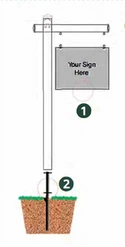
Design Verification: Before ordering, require the manufacturer to provide an overturning-stability calculation under wind load and accidental collision. For example: assuming a 50-year return-period wind pressure of 0.45 kN/m², a post above-ground height of 1.2 m, and a foundation embedment depth of 0.5 m, the calculated factor of safety against overturning should be no less than 1.5. If the manufacturer cannot produce this calculation, their post has not been engineered - it has simply been extruded. For engineered anchoring solutions with full stability documentation, explore YUPSENI's PVC marker post anchoring systems →

product-416-823

PVC marker post below ground anchoring system showing concrete anchor block flange connection barbed anti extraction fins and ground sleeve replacement method


Fig. 2 - The hidden half: three tiers of below-ground anchoring design, flanged post bolted to precast concrete block, anti-extraction barbs on the buried section, ground-sleeve system enabling tool-free post replacement without excavation.

The Long-Term Return: Purchase Price Is Only 20% of Total Lifecycle Cost

Many procurement professionals habitually compare unit prices and stop there - overlooking a truth that experienced project managers learn the hard way: the combined costs of installation, replacement, information re-marking, and failure response frequently exceed the product's purchase price by a factor of 5–10.

Replacing a ¥200 ten-year post with a ¥50 disposable looks, on the invoice, like a ¥150 saving. But factor in: the labor crew dispatched for replacement within three years, the vehicle mobilization cost, the re-production of the marking information, and - most significantly - the liability exposure created when a fallen or illegible marker post causes a utility strike, a boundary dispute, or a vehicle incident. The real loss can easily exceed ¥2,000. The cheap post was never cheap. It was a deferred catastrophe with a modest down payment.

Smart Procurement Strategy: Write these five parameters directly into the tender technical specification. Explicitly require: (1) virgin-resin formulation with documented weathering test data, (2) integrally co-extruded internal rib structure with specified section modulus, (3) co-extruded or laser-engraved marking technology with abrasion-test certification, (4) quantified low-temperature impact strength (Charpy ≥30 kJ/m², embrittlement ≤−25°C), and (5) engineered below-ground anchoring with overturning-stability calculation. When the specification speaks in numbers and physical tests, the disposables are excluded before the bidding envelope is opened. 


Ready to Specify Marker Posts That Outlast the Project?

YUPSENI manufactures engineered PVC marker posts with co-extruded UV-stabilized markings, integrally reinforced rib structures, cold-rated formulations for extreme climates, and modular anchoring systems. Factory-direct supply backed by ISO 9001 & ISO 14001 certified manufacturing, 30+ production lines, and technical support across 100+ countries.

Explore PVC Marker Posts → Request Technical Datasheets →
Frequently Asked Questions About PVC Marker Posts
 

Practical answers to the most common procurement and specification questions about durable PVC marker posts for property, utility, and municipal applications.

Q1: What is the most important parameter to check when buying marker posts for outdoor use?

A: If you can only verify one thing, make it the base resin formulation - specifically, virgin vs. recycled material. This single parameter cascades into every other performance dimension: UV resistance, low-temperature toughness, impact strength, and marking-bond durability all ultimately trace back to the quality of the polymer matrix. A marker post built from 100% virgin PVC or PE resin with properly compounded UV stabilizers (3–5% loading) and antioxidants will deliver 10–15 years of outdoor service. A post built from recycled material will begin degrading within a single season. The flame test described in Parameter 1 provides a rapid field screening method; a third-party accelerated weathering report (xenon-arc, ≥2,000 hours) provides documentary proof. For guaranteed virgin-resin products, source from YUPSENI's certified PVC profile manufacturing →

Q2: How can I quickly test whether a marker post will survive cold winters?

A: The freezer-and-hammer test provides a decisive field evaluation. Place the sample post in a domestic freezer at −18°C for 2 hours. Remove and strike immediately with a hammer. A quality post with a low embrittlement temperature (−30°C or below) will deform elastically - it may dent but will not fracture. A post with a high embrittlement point (typical of recycled-material products) will shatter cleanly. This test takes two hours and requires equipment available in any site office. It reliably screens out products that would fail catastrophically during the first winter freeze. For cold-climate projects, also request the manufacturer's Charpy impact strength values at −20°C and the measured embrittlement temperature per GB/T 5470 or ISO 974.

Q3: What marking technology lasts as long as the post itself?

A: Only fourth-generation technologies - specifically, co-extruded embedded marking and laser-engraved text - achieve marking durability equal to the post body's service life. Co-extruded marking works by injecting UV-stabilized pigmented resin 0.5–1 mm below the post surface during extrusion; the marking material and the post body share the same polymer base and undergo molecular-chain interdiffusion, making delamination physically impossible. Laser engraving ablates micron-scale grooves directly into the surface - the information exists as permanent physical topography, not as applied pigment. Both technologies survive the 50-stroke copper-brush abrasion test without visible degradation. All earlier generations - adhesive stickers, screen-printing ink, UV-printed + clear-coated systems - fail within 6 months to 5 years. When specifying, explicitly require co-extruded or laser-engraved marking and request the manufacturer's abrasion-resistance test report.

Q4: Why do some marker posts lean or fall over within a year of installation?

A: The root cause is almost always inadequate below-ground anchoring design. Disposable posts rely solely on a smooth extended section buried in soil - as the soil settles after rain, softens in wet seasons, or heaves during freeze-thaw cycles, frictional grip is progressively lost and the post begins to lean. Engineered solutions prevent this through three proven mechanisms: (1) a flanged base bolted to a precast concrete anchor block - the mass and geometry resist overturning; (2) anti-extraction barbs or friction fins on the buried section - like roots, they mechanically interlock with the soil; (3) a ground-sleeve system that isolates the post from direct soil movement. For projects where post stability is critical, require the manufacturer to provide an overturning-stability calculation demonstrating a safety factor ≥1.5 under the design wind load for the installation location.

Q5: Are more expensive marker posts actually cheaper in the long run?

A: Yes - and the mathematics is straightforward once all costs are accounted for. A ¥50 disposable post may need replacement within 1–2 years due to fading, fracture, or leaning. The replacement cost includes not just the new post but labor dispatch, vehicle mobilization, potentially traffic management, re-creation of the marking information, and the administrative overhead of procuring and coordinating the replacement. Conservatively, a single replacement event costs 3–5 times the post's unit price. A ¥200 ten-year-grade post that requires zero replacement over a decade delivers a total cost of ownership that is typically 40–60% lower than cycling through disposable alternatives. The procurement saving on the cheap post is an illusion - it is simply a deferred cost, multiplied by the logistics of failure response. For a full lifecycle-cost comparison tailored to your project, contact YUPSENI's technical procurement support →

Q6: Can marker posts be replaced without digging up the foundation?

A: Yes - and this is the defining operational advantage of a well-designed anchoring system. Two approaches enable foundation-preserving post replacement. The flanged-base + anchor-block system uses a bolted connection between the post flange and a buried concrete block; unbolt the old post, bolt on the new one - the foundation remains undisturbed. The ground-sleeve system takes this further: a permanent PVC or steel sleeve is buried flush with the ground surface; the post simply slides into the sleeve with a sand fill; to replace, pull the old post, slide in the new one - zero excavation, zero tools beyond what is needed to lift the post. This second approach is particularly valuable for utility and pipeline marker posts where signage must be updated periodically to reflect changes in infrastructure. Both methods reduce replacement labor by 80–90% compared to traditional dig-and-backfill cycles.

Conclusion: Five Parameters, One Decade of Certainty

Real estate marker posts may appear insignificant - thin plastic columns dotting the landscape - but they are, in reality, the outermost tactile point where quality, responsibility, and long-term thinking make physical contact with the world. The next time you walk through a residential compound, a construction site, or along a roadside and notice marker posts whose lettering remains crisp and whose stance remains upright, take a second look. Behind that quiet, unremarkable presence likely stands a precise resin formulation, a structurally optimized rib design, and an anchoring system engineered to absorb ten years of wind, frost, and the occasional vehicle bump without complaint.

For the buyer, these five parameters are your measuring stick. What they measure is not merely the price difference between two outwardly similar plastic posts. What they measure is the difference between a product you will replace, and replace again, at mounting hidden cost - and a product you install once and trust for a decade. That trust - in boundary markers that stay where they are put, saying what they are meant to say, season after season - is the real return on a specification well written.


YUPSENI Team

With over 23 years of experience in PVC extrusion and polymer formulation technology across a 111,480 m² manufacturing facility with 30+ production lines, the YUPSENI technical team serves customers in 100+ countries. Our PVC marker post and outdoor profile range spans co-extruded UV-stabilized boundary markers, reinforced utility signage posts, and engineered anchoring systems - all manufactured with virgin PVC resin, cold-rated impact-modified formulations, and documented weathering performance in ISO 9001 & ISO 14001 certified facilities.
Learn more about YUPSENI →

You Might Also Like